Dissertation
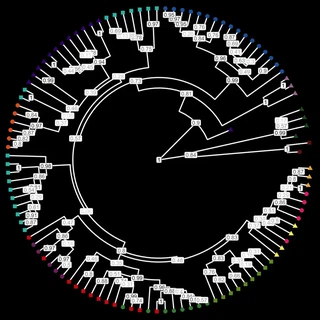 Maximum clade credibility tree of Mixtecan
Confronting challenges in historical linguistics: Quantitative approaches to dialect area subgrouping and tone change in Mixtec
Abstract: This dissertation investigates the dynamics of language change in the Mixtec languages, a branch of Mixtecan (Otomanguean). Spread over a large mountainous area in southern Mexico, the history of this language family is characterized by repeated migrations, diversified local varieties, and ongoing inter-varietal contact, leading to its characterization as a dialect continuum. Mixtec languages are also well known for their intricate systems of grammatical and lexical tone, which have to be reconstructed to Proto-Mixtec and beyond.The first study applies a Bayesian phylogenetic model to lexical cognacy data of 137 Mix- tecan varieties. This model recovers the three main branches of Mixtecan (Mixtec, Triqui, and Cuicatec) as well as a number of well-supported higher- and lower-level groups within Mixtec. It also identifies varieties that are only loosely connected to the rest of the family and thus reveals that there are both wave-like and tree-like diversification processes at work and shows that subgrouping is possible and informative in a language family characterized as a dialect continuum. The second study provides a comprehensive account of sound changes in Mixtec. The sound changes are coded as fine-grained variables in a framework adapted from multivariate typology, and analyzed using computational methods. This allows for high accuracy and detail with regards to the sound changes but also for making visible larger patterns and tendencies. The latter show that the distribution of Mixtec sound changes generally aligns well with the subgroups proposed in the first study. The third study addresses the question of whether tones can be used for subgrouping and whether or not they change faster than segments. Building on the same typological framework as for the second study, I show that tone change can be analyzed in the same way as segmental change. I apply quantitative methods to calculate phylogenetic signal and rates of tonal versus segmental change based on the family tree obtained in the first study. The results show that tone change does not differ from segmental change in any meaningful way; that is, tones also show phylogenetic signal and their rates of gain and loss are not different from those of segments. Each study is designed to address the research questions in a empirical way, by including all sufficiently reliable and available Mixtec language data, which will be shared in public repositories along with all aspects of data handling, coding, and scripts used in the analyses.
Available on ProQuest.
Disclaimer: My dissertation is cumulative and two of the three chapters are published as articles in an updated version, which superseed the dissertation version:
- Chapter 1: Auderset et al. 2023. Journal of Language Evolution 8(1)
- Chapter 2: The database part is published in Auderset & Campell 2024. Journal of Open Humanities Data 10(1). The sound change part is not yet published as a separate paper and the chapter of the dissertation should be cited.
- Chapter 3: Auderset 2024. Language Dynamics and Change 14(1)

I research how languages diversify over time and how we can trace and explain diversification. I work on tone and sound change, subgrouping, and person marking, with a focus on Mixtecan (Mexico). I combine quantitative methods and data-driven comparison with detailed analyses of individual varieties. To develop the empirical foundations needed, I conduct long-term fieldwork on Mixtec and Cuicatec varieties and develop openly available cross-linguistic resources.
I’m currently a postdoctoral researcher in the Department of Linguistics at the University of Bern. I have a PhD in Linguistics from the University of California, Santa Barbara (USA) and the Department of Linguistic and Cultural Evolution at the Max Planck Institute for Evolutionary Anthropology in Leipzig (Germany). My dissertation is a collection of three articles on Mixtec(an) language history using qualitative and quantitative methods.
News and updates:
- I got a Firebird Research Grant for continuing the documentation of Santos Reyes Pápalo Cuicatec
- November 2026: I will give a talk at the Transalpine Typology Meeting in Munich on Mixtec pronouns and classifiers
- August 2026: Co-hosted a workshop on Microtypology at SLE with Linda Konnerth and Sergey Say
- July 2026: I contributed to a position paper on language documentation infrastructure (/publication/gessler-2026-the-missing)
- April 2026: New database paper out in Journal of Open Humanities Data